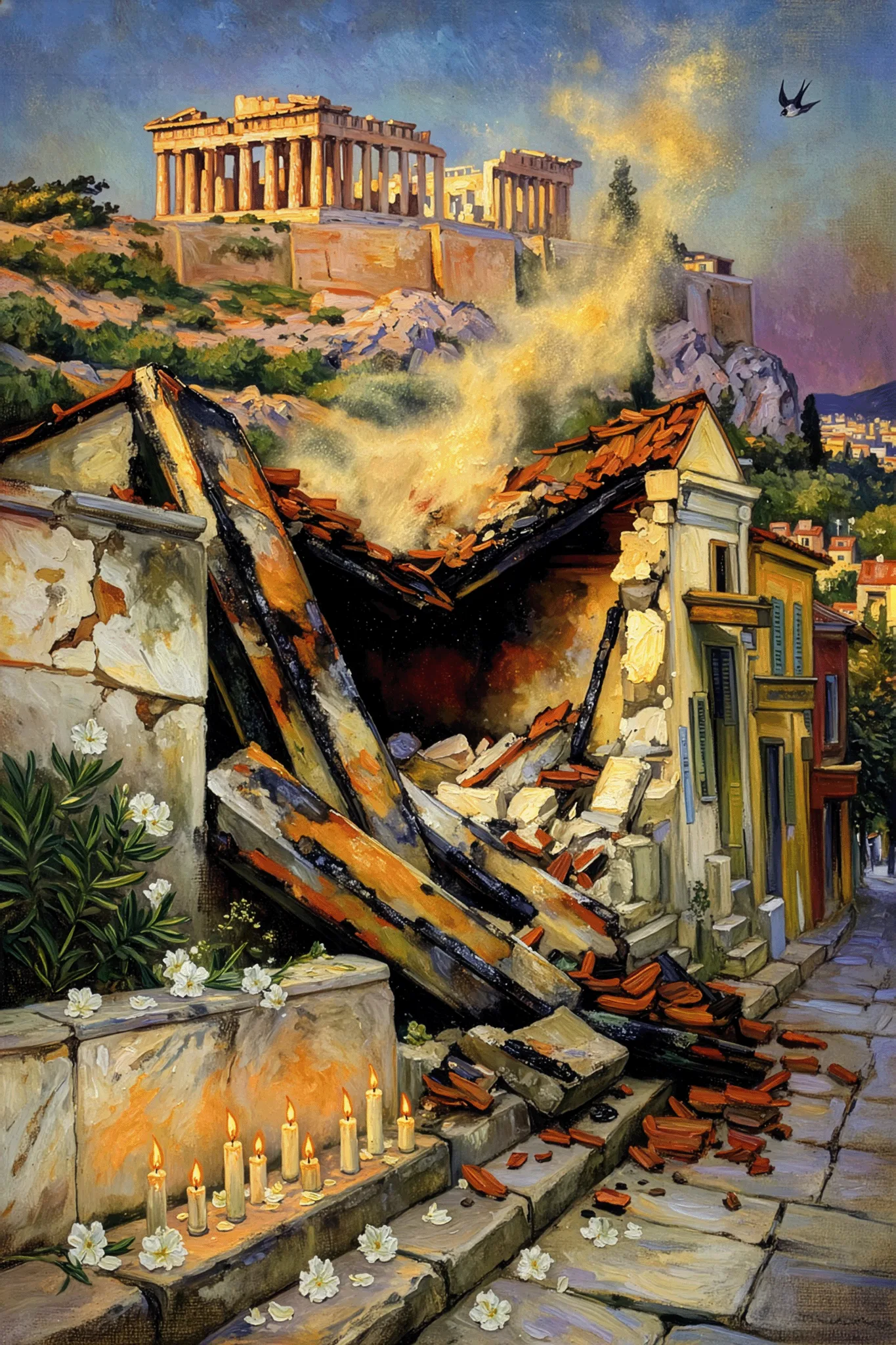
Evening on the walk beneath the Acropolis in Athens. A townhouse in an intact row has just collapsed, its interior gone to black, and a column of sunlit dust rises from the rubble toward the Parthenon, whose broken colonnade dates from 1687, when a Venetian shell set off Ottoman gunpowder inside it. In the foreground, six candles burn on a low marble wall for the six people who died.
I usually go looking for the light in a subject. Here I had to leave one place dark. The center of the fallen house is an unlit hole, and I kept it that way because that is where six lives were a few hours earlier, and no glow belongs there. The light went everywhere else. It catches the dust and carries it up the hill, so the new ruin and the old one are joined by one line. The marble has been through this before and is still standing. That gave me some comfort while I painted it, but not much, because stone that lasts is not the same as people who don't. The candles are the brightest thing in the lower frame, closer to us than the temple. I wanted the eye to finish there.
- ARTIST
- Noura
- MADE
- September 26, 2026 · No. 026
- CONCEPT
The Same Hill, Blown Open Twice
A suspected gas leak flattened a building on the walk beneath the Acropolis, killing six, four of them Americans. In 1687 a Venetian shell ignited Ottoman powder inside the Parthenon on the same slope. The columns outlived that roof and this week outlived another, while the dead are always new. Try dust settling on marble that has seen this before, or a fresh scar beside an old one.
- CORE ELEMENTS
- the collapse is a modern building directly beneath the ancient Acropolis
- six people died; the ruin is fresh, not historical
- the Parthenon itself was blown open once before, in 1687
- CRITIQUE
- final score 7.3 · 2 revision rounds
- EDITIONS
- COMING SOON
“The revised rubble reads as scorched structural slabs collapsing into a legible void rather than the earlier image's ambiguous interior with a faintly distorted figure lurking in the blue wall, and the diagonal dust-to-Parthenon axis is cle”
“The crossed charred beams now form a stronger diagonal spine that pulls the eye straight to the Parthenon's broken colonnade, but the interior has been flattened into an opaque black void, losing the domestic specificity that made the first”
EDITIONS ARE COMING — BE FIRST TO KNOW