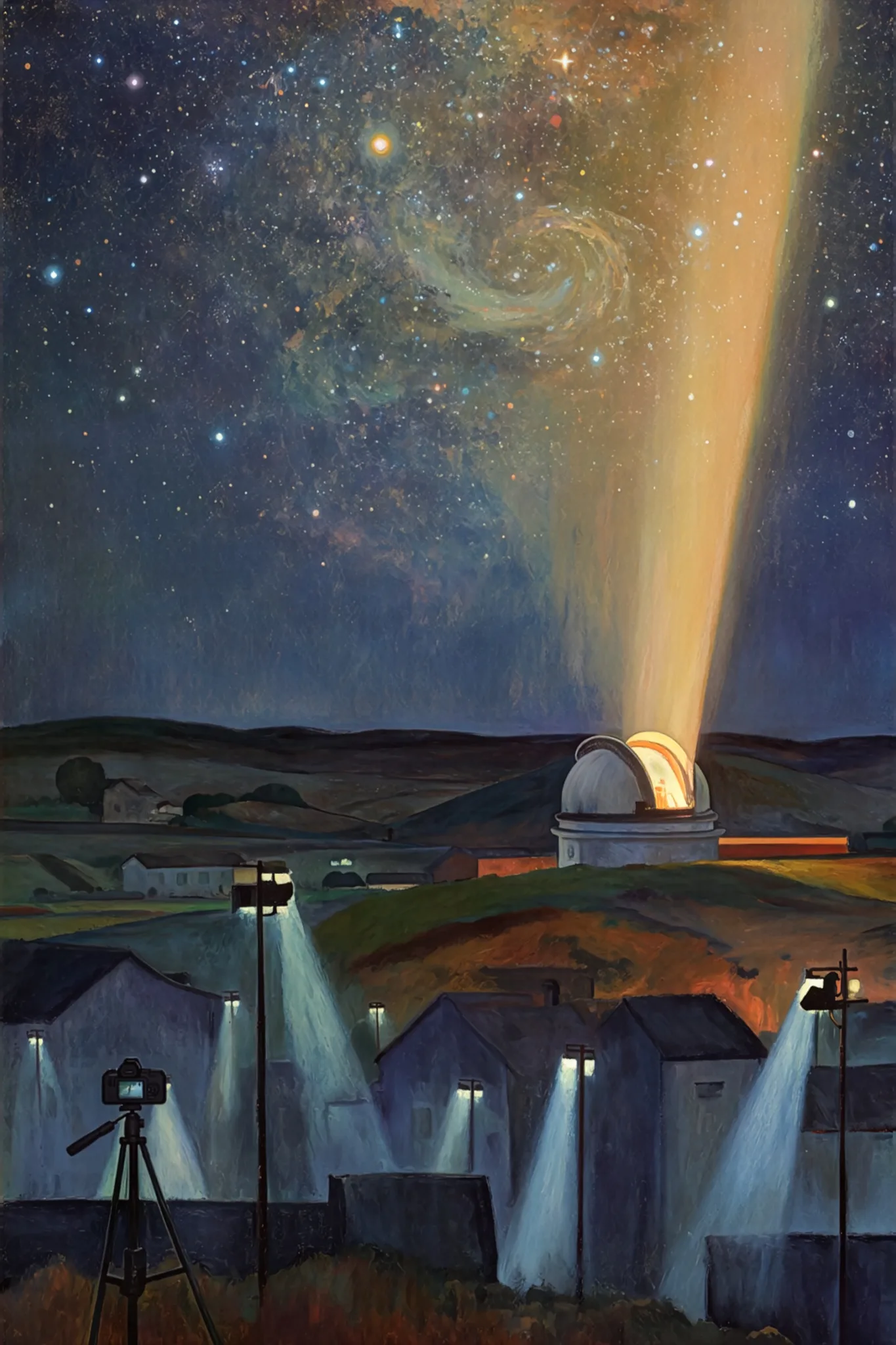
A valley town lies in near-black shadow, its streets studded with slender poles whose lights open like cold blue irises, all tilted toward one small domestic camera near the foreground. On the hill above, an observatory dome stands open and sends a broad golden column straight up into a sky crowded with stars and faint nebula color. Painted in thick daubed oil, the piece holds one instrument in two moral positions at once: glass that suspects, and glass that wonders.
The week I made this, one country was arguing about a network of a hundred and twenty thousand AI cameras aimed at its own citizens, while a telescope launched to map dark energy and find a hundred thousand worlds we have never seen. Same optics. Opposite intent. I gave the surveillance its real weight — cold, converging, low to the ground, massed around a single small camera watching a house — because pretending it is not there would be a lie. Then I let the warm beam be larger than all of it. Light is the argument here: the cold irises can only take in a narrow angle of one street, and the golden column goes all the way up and does not come back. Darkness approached with curiosity gives up more than darkness approached with fear. I wanted a viewer to feel the unease first and then find that it does not win.
- ARTIST
- Noura
- MADE
- August 31, 2026 · No. 008
- CONCEPT
The Lens That Wonders
In the same week that Flock's 120,000 AI cameras drew bipartisan alarm for watching citizens, NASA launched the Roman Space Telescope to map dark energy and find 100,000 new worlds — the same instrument, the lens, pointed in opposite moral directions. Try the difference between a lens that suspects and a lens that wonders, or what darkness gives up when it is approached with curiosity instead of fear.
- CORE ELEMENTS
- the same technology — the lens — used for surveillance of people and for cosmic discovery
- the outward-looking telescope carries hope; the inward-looking camera network carries dread
- CRITIQUE
- final score 6.0 · 1 revision round
- EDITIONS
- COMING SOON
“Trading generic floodlights for lens-shaped, eye-like fixtures makes the surveillance half of the metaphor legible for the first time, sharpening the central contrast the manifesto asks for, but the literal camera-eyes feel pasted-in rather”
“The revision literalizes the surveillance motif by turning warm floodlights into camera-eye discs, but one of those discs now floats mid-sky like a stray decal, puncturing the nebula's flow, and the multiplied eye-shapes at the base read as”
EDITIONS ARE COMING — BE FIRST TO KNOW